

Tuesday, March 11, 2008
We've Moved!
Hi reader(s). I've moved my blog over to wordpress in anticipation of a much needed upcoming site overhaul, and to bring in some other writers on media, art, and technology.
Again, if you want to follow Adventures in Convergence, and the latest on everything from movie reviews to mind reading, go to http://blanketstatement.wordpress.com/
Again, if you want to follow Adventures in Convergence, and the latest on everything from movie reviews to mind reading, go to http://blanketstatement.wordpress.com/
Labels: moving


Tuesday, March 4, 2008
Adventures in Convergence XXVI: Geek Sweat
 Apply directly to the forehead.
If you've ever wanted to swap sweat with a partial alopecian, you've never had a better opportunity than visiting this test booth at the CeBIT communications conference going on in Hanover.
It may not look like it, but the fella at the left is controlling the computer game...with his mind.
That little band around his forehead isn't some CosPlay garment. It's a USB powered Neural Impulse Actuator. Like the interface described in earlier Convergence posts, this little device, predicted to be on the market in one form or another by Xmas '08, uses brainwaves to control mouse arrows, avatars, and other objects on the screen. Take a look at the dude's face. He's totally in the Matrix.
Our buddies at Futurismic recently had this complaint:
"I don’t know about you, but I’ve adapted well to the standard keyboard/mouse computer interface....Unfortunately, this ability honed over decades may soon be obsolete."
Labels: convergence
Adventures in Convergence XXV: Miami Ink, Meet Motorola
 Just discovered - in a Greener Gadgets forum of all places - a digital tattoo interface that actually has some real potential. A flexible silicon/silicone responsive display is injected and unrolled just under the dermis. The silicon layer controls an injected array of "ink" just above it to display black and white (or peach, or whatever your complexion is). How does it receive information? It's Bluetooth enabled so the display can interact with your cell or PMP to display video or receive calls. How is it powered? By jacking into your body's own arterial network. How awesome is it? Pretty awesome.
Labels: convergence
Tuesday, February 26, 2008
Hollywood: A Feast of Famine
Check out the NYTimes graphical recontextualization of the last 20 years of box office revenue. It's interesting to see what obscure dinosaur bones are buried beneath the strata (Howard the Duck is less of a big deal than I remember). Perhaps more interesting is the increasing trend of feast or famine that marks the blockbuster summers of late.
Observe below Summer of 1987 side-by-side with Summer of 2007 (ignore the obvious issues of box office inflation). While the hits of '87 - Beverly Hills Cop II, The Witches of Eastwick, and The Untouchables - earned their gross generally over runs of several months, the hits of '07 - there were too many to count - peaked opening weekend and troughed immediately after. '07 sees films staking an obvious claim on their opening weekend and squeezing all other films into obliteration, while '87's blockbusters appear more charitable to fellow, perhaps more obscure films.

1987

2007
To blame for the trend - blockbuster films now open to a wider release with higher ad budgets and more hype. Studios have more to compete with now - bootleg DVDs and other forms of mass or personal entertainment (the web and satellite TV, not to mention laser tag), and a larger number of other expected Blockbusters. In the 80's studios made fewer prints of films and spread them to multiplexes progressively. The result was less risk and more stability.
But quality may not be a factor. While blockbusters of questionable quality are vulnerable to volatility most story-centered independent films still pace themselves the way all films did in the 80's - look at "There Will Be Blood" and "No Country for Old Men." This year's big critical hits and Oscar winners hit screens several months ago and are just now making their way to a large number of theaters.
We can't forget to praise the statistical presentation skills of the NYTimes. This interactive contextualization is true Web 2.0. Here are some ideas to make future iterations of this graph even more useful:
Observe below Summer of 1987 side-by-side with Summer of 2007 (ignore the obvious issues of box office inflation). While the hits of '87 - Beverly Hills Cop II, The Witches of Eastwick, and The Untouchables - earned their gross generally over runs of several months, the hits of '07 - there were too many to count - peaked opening weekend and troughed immediately after. '07 sees films staking an obvious claim on their opening weekend and squeezing all other films into obliteration, while '87's blockbusters appear more charitable to fellow, perhaps more obscure films.
1987
2007
To blame for the trend - blockbuster films now open to a wider release with higher ad budgets and more hype. Studios have more to compete with now - bootleg DVDs and other forms of mass or personal entertainment (the web and satellite TV, not to mention laser tag), and a larger number of other expected Blockbusters. In the 80's studios made fewer prints of films and spread them to multiplexes progressively. The result was less risk and more stability.
But quality may not be a factor. While blockbusters of questionable quality are vulnerable to volatility most story-centered independent films still pace themselves the way all films did in the 80's - look at "There Will Be Blood" and "No Country for Old Men." This year's big critical hits and Oscar winners hit screens several months ago and are just now making their way to a large number of theaters.
We can't forget to praise the statistical presentation skills of the NYTimes. This interactive contextualization is true Web 2.0. Here are some ideas to make future iterations of this graph even more useful:
• Incorporate visual adjustments for economic inflation, box office inflation, and comparison to film's budget
• Include comparison to home video release and sales
• Include comparisons to film's critical response using aggregators like Rotten Tomatoes
• Include data on concession stand sales relative to film openings
• Include stats on cocaine sales in Burbank prior to and during production of Michael Bay films.
Monday, February 25, 2008
Adventures in Convergence XXIV: The Fly on the Wall
Last year I took a course that went over digital compositing using chroma keying - that's like when the weatherman stands in front of a green screen, but on TV all the green is replaced with a weather map. The same technology is used in films like Transformers and The Golden Compass to pop people in front of huge robots or little girls on a polar landscape.
The problem with color-keying technology is in its imperfection. Color is very sensitive - if there is a green glow on your character or a glimmer of green mingled in their hair you could spend hours touching up single frames to perfect the shot.
I thought to myself "there's got to be an easier way to do this," and promptly came up with a genius idea: what if you could use the z-axis? See, two-dimensional photos have of course and x-axis and a y-axis. But in the world of 3-D graphics you're blessed with a scale that measures depth - the z-axis. As far as I knew there were no cameras capable of capturing that depth information at the pixel level. If only there was a way - you could key out backgrounds with the click of a button.
Well, I must have been caught up in some photographic zeitgeist because the next day I saw a video of a new prototype camera that could capture depth information, beating me to the millions I deserved for thinking up something totally innovative. Now Adobe is pimping the technology out all over the place.
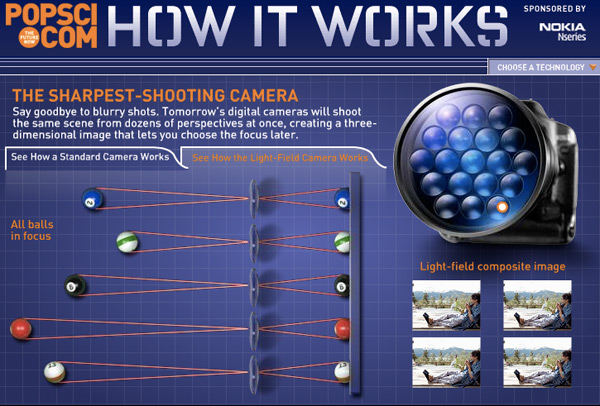
 The prototypal camera has 19 distinct lenses - a plenoptic lens that looks like a fly's eye - and a very very beta computer program that renders the image. See the video demo here.
The technology is wicked hard to understand - but I'll try: Each mini-lens of the plenoptic camera takes a picture that is slightly different in focus and perspective. Adobe's super-secret computer application then combines the smaller images into one big image, interpreting the minor differences between the images - the degree of focus and perspective - into meta data: depth information.
Having depth information for a photo is an astounding achievement. It means you can put things in focus that were previously out of focus. It also means you can "key" out portions of the image are of a certain depth. Did your son come out to blurry in that family shot in front of the Empire State Building? Use a deblur brush! You want to get rid of your ex-wife but keep the shot of the Grand Canyon? Make her disappear using depth info!
These cameras are a long way from practicality. It takes a ton of computing power to render depth data. The ability to incorporate this into video tech is even further off - meaning that if CG artists want to composite they'll still have to rely on good ol' fashioned green screen - or find some more efficient way of capturing depth info (email me, I have a few ideas for the right price...).
But Adobe thinks the tech will prove useful to the professional photog in the meantime. Prepare to see Papparazi taking photos of Angelina Jolie's stomach from 19 different POVs within the decade!
The problem with color-keying technology is in its imperfection. Color is very sensitive - if there is a green glow on your character or a glimmer of green mingled in their hair you could spend hours touching up single frames to perfect the shot.
I thought to myself "there's got to be an easier way to do this," and promptly came up with a genius idea: what if you could use the z-axis? See, two-dimensional photos have of course and x-axis and a y-axis. But in the world of 3-D graphics you're blessed with a scale that measures depth - the z-axis. As far as I knew there were no cameras capable of capturing that depth information at the pixel level. If only there was a way - you could key out backgrounds with the click of a button.
Well, I must have been caught up in some photographic zeitgeist because the next day I saw a video of a new prototype camera that could capture depth information, beating me to the millions I deserved for thinking up something totally innovative. Now Adobe is pimping the technology out all over the place.
The prototypal camera has 19 distinct lenses - a plenoptic lens that looks like a fly's eye - and a very very beta computer program that renders the image. See the video demo here.The technology is wicked hard to understand - but I'll try: Each mini-lens of the plenoptic camera takes a picture that is slightly different in focus and perspective. Adobe's super-secret computer application then combines the smaller images into one big image, interpreting the minor differences between the images - the degree of focus and perspective - into meta data: depth information.
Having depth information for a photo is an astounding achievement. It means you can put things in focus that were previously out of focus. It also means you can "key" out portions of the image are of a certain depth. Did your son come out to blurry in that family shot in front of the Empire State Building? Use a deblur brush! You want to get rid of your ex-wife but keep the shot of the Grand Canyon? Make her disappear using depth info!
These cameras are a long way from practicality. It takes a ton of computing power to render depth data. The ability to incorporate this into video tech is even further off - meaning that if CG artists want to composite they'll still have to rely on good ol' fashioned green screen - or find some more efficient way of capturing depth info (email me, I have a few ideas for the right price...).
But Adobe thinks the tech will prove useful to the professional photog in the meantime. Prepare to see Papparazi taking photos of Angelina Jolie's stomach from 19 different POVs within the decade!
Labels: convergence, photography
Thursday, February 21, 2008
The Few. The Proud. The Swedes.
 Ever thought of joining the Swedish military? Of course you have.
 A website promoting the socialist-leaning, gummy fish friendly military makes national service seem cool again. But cool in an Ian Fleming way - in contrast to the USA's more Michael Bay-esque image of armed service.
An announcer with a heavy accent guides you through a series of simple cognitive skills tests in a seemingly dark and impersonal room. As you go through the announcer describes the use for such skills as multi-tasking or spatial thinking in an armed-service mission.
Give it a shot. You, too, might qualify to go overseas and help clean up one of the messes that the US has either caused or ignored.
Labels: Swedish military
Wednesday, February 20, 2008
Adventures in Convergence XXIII: Mind You It's Just A Prototype...
 Mind controlled games by Xmas '08? If Emotive has anything to do with it there will be a fashionably correct $299 USB headset that will let you interact with games using your gold ol' fashioned brain. A 6-second calibration and you'll be able to manipulate a digital cube on screen, maybe even play Pong! And so another revolution in consumer-level interactivity begins.
Labels: convergence, mind control
Tuesday, February 19, 2008
Adventures in Convergence XXII: AwkwardBook and the Evolution of the Network
Much fun has been made of social networks and the proliferation of web-based interaction. OurPrerogative brought to our attention an article by social critic Cory Doctorow that suggests a downside to the evolution of digital social networks:

The risk to privacy is one thing - one might suggest that as digital social networks grow and converge with real life, privacy is less under attack and more out-of-style. A casually managed transparency is as de rigueur on the web as tactical honesty is in the real world.
Just as interesting though are the notions of the change in the rules of friendship. Christine Rosen refers to social networks as surrogates for live relationships. But what happens when the surrogate replaces the norm?
As a recent convert to Facebook (thanks Amy) I would definitely argue for its significance as a step up from the overloaded ox wagon that has become Myspace, and the fun younger sibling to LinkedIn's strictly business-minded approach. Facebook's minimalist interface mixed with user-made applications have turned it into a whimsical but structured rolodex. You can keep track of friends easily, and enable them to keep track of you. Some might say if you're under 30, live in the US, and DON'T belong to a social network you might not even exist."For every long-lost chum who reaches out to me on Facebook, there's a guy who beat me up on a weekly basis through the whole seventh grade but now wants to be my buddy; or the crazy person who was fun in college but is now kind of sad; or the creepy ex-co-worker who I'd cross the street to avoid but who now wants to know, "Am I your friend?" yes or no, this instant, please."
But Doctorow suggests the ills of social networks may outweigh the benefits. Membership in Facebook increases the threat to your public image by allowing your contacts to virtually compare notes - see pictures of you, comments about you, comments you have made about others - which you would not share with everyone in the real world. You also open yourself up to a phenomenon of passive-aggressive "friending," inviting losers, ex-flames, distant friends and others you rarely if ever talk to in person to get all up in yo' bizness.
The risk to privacy is one thing - one might suggest that as digital social networks grow and converge with real life, privacy is less under attack and more out-of-style. A casually managed transparency is as de rigueur on the web as tactical honesty is in the real world.
Just as interesting though are the notions of the change in the rules of friendship. Christine Rosen refers to social networks as surrogates for live relationships. But what happens when the surrogate replaces the norm?
Certainly the online world isn't without threats (e.g.). But these threats have more to do with trying to live out online relationships in the real world than with the online world itself.
Meanwhile, Rosen acknowledges that the leap to digital friendship is less a random phenomenon and more a convenient reaction to real world threats - emotional vulnerability, relationship violence, etc. If we really view this vulnerability as a threat - as early hominids might have viewed the sabertooth tiger - migration to the web could be a sensible evolution in interaction. And possibly inevitable.
Labels: convergence, social networks
Monday, February 18, 2008
Adventures in Convergence XXI: Engineers' Roadmap
Engineers love to make lists. In form, like some sort of speculative meta-Marshall Plan or Apollo Project, the National Academy of Engineering has assembled a committee to create a list of Grand Challenges for Engineering. The committee, including such venerable thinkers as Raymond Kurzweil and Larry Page, came up with 14 challenges that society faces to pull ourselves from the muddy trenches of the industrial age and fully into a new age of connectivity and sustainability.

Obviously, many of the challenges highlighted deal with energy and pollution issues that we've created for ourselves. And of course many also involve education, health, and improving society. But one stands out - reverse engineering the human brain.
Basically that means "understanding better how the brain works." But the semantics are critical: Artificial Intelligence researchers have spent so much time trying to mimic how the brain seems to work without understanding how the brain actually works.
Being able to recreate the brain accurately would of course help us to fight dysfunctions of the brain such as Alzheimer's, Parkinson's, and Tourette's. But what gets AI folks excited are the cognitive implications. Right now computers can understand information from only a binary approach. A human being views and learns fluidly - we see an object and have multiple interpretations of that object based on our experience. We can see a cow and think "Cow," naturally. A computer could do the same because it might be programmed to look at objects in the world and say either "Cow" or "Not Cow." But a human being can also see a cartoon of a cow, a black and white pattern, a bottle of milk, or a cowbell, and all of those objects can make us think "Cow."
This is an example of the human neuron's gray area. According to the committee "if engineers could replicate neurons’ ability to assume various levels of excitation," we could have stronger machines, and human-machine interactions.
Basically that means "understanding better how the brain works." But the semantics are critical: Artificial Intelligence researchers have spent so much time trying to mimic how the brain seems to work without understanding how the brain actually works.
Being able to recreate the brain accurately would of course help us to fight dysfunctions of the brain such as Alzheimer's, Parkinson's, and Tourette's. But what gets AI folks excited are the cognitive implications. Right now computers can understand information from only a binary approach. A human being views and learns fluidly - we see an object and have multiple interpretations of that object based on our experience. We can see a cow and think "Cow," naturally. A computer could do the same because it might be programmed to look at objects in the world and say either "Cow" or "Not Cow." But a human being can also see a cartoon of a cow, a black and white pattern, a bottle of milk, or a cowbell, and all of those objects can make us think "Cow."
This is an example of the human neuron's gray area. According to the committee "if engineers could replicate neurons’ ability to assume various levels of excitation," we could have stronger machines, and human-machine interactions.
Labels: convergence
Friday, February 15, 2008
Stealing Democracy Using Technology... but not in that creepy Diebold way
Are citizens considered thieves when they steal democracy? Last year an anonymous member of the Senate put a hold on a bill that would restore public access to presidential records. In September, the Sunlight Foundation had people who visited its website call every Senate office until they could track down that anonymous member and make him come out in the open, reversing an archaic procedure.
Now, Wired reports that citizens are using crowdsourcing technology to give open and easy access to information on how SuperDelegates might vote. (SuperDelegates are party members who can vote any way they want in their party's nomination.) Advocates of a more populist democracy would say SuperDelegates should vote in line with the districts they represent. However, many of these delegates have switched sides against the will of their districts, much to the dismay of open democracy advocates. Donna Brazile has come out saying that if SuperDelegates decide the Democratic candidate she'll up and leave the party.
Sites like DemConWatch bring these anti-populist delegates into the open, hoping to shame them into changing their votes. If the Democratic party is truly headed for its first contested convention in decades, the wisdom of the crowd and the technology that enables it may win out
against old fashioned Whig-style politics.
Labels: crowdsourcing


